How to Deal with a Narcissist: A Guide to Protecting Your Peace & Sanity
Walking on eggshells is exhausting. If you constantly feel confused, drained, or like you are losing your grip on reality, you are not alone. Learning how to deal with a narcissist isn't just about managing a difficult relationship; it is about reclaiming your own mental health.
Whether this person is a spouse, a parent, or a boss, their behavior often follows a predictable, toxic pattern. They may demand excessive admiration, lack empathy, or manipulate situations to make you feel at fault. However, you have more power than you realize.
This guide provides actionable psychological strategies to protect your energy. We will cover specific communication scripts, boundary-setting techniques, and ways to gain objective clarity. You can also explore our narcissism test to better understand the behavioral patterns you are witnessing.

First: Distinguishing Narcissism from Selfishness
Before you can effectively manage the situation, you need to validate your reality. It is common to ask, "Are they really a narcissist, or just difficult?" While we cannot offer a clinical diagnosis here, distinguishing between garden-variety selfishness and pathological traits is the first step toward clarity.
The Core Difference: Empathy Deficits vs. Ego
A selfish person may prioritize their needs over yours, but they are capable of feeling guilt. If you explain that they hurt you, a selfish person might feel bad and apologize.
In contrast, someone with strong narcissistic traits often lacks this fundamental capacity for empathy. They do not just prioritize themselves; they may not fully recognize you as a separate person with valid feelings. If you express pain, they might get angry at you for making them look bad. This "empathy deficit" is a hallmark sign you are dealing with a narcissist.
Understanding "Narcissistic Supply": Why They Need Your Reaction
Why do they provoke you? The answer lies in a concept called "Narcissistic Supply."
Think of their ego as a bucket with a hole in the bottom. They constantly need validation, admiration, or even your fear and anger to fill it up. This is their "supply."
- Positive Supply: Praise, adoration, compliance.
- Negative Supply: Arguing, crying, defending yourself.
To them, any reaction proves they matter. Understanding this changes the game. Once you realize they are hunting for a reaction—any reaction—you can choose not to give it to them.
The Golden Rule: Manage Your Expectations
The biggest mistake compassionate people make when learning how to deal with a narcissist is trying to "fix" them. You might think, "If I just love them enough or explain myself clearly enough, they will change."
Accepting They Will Not Change (The Hard Truth)
This is painful, but necessary: You cannot change them. You cannot love them into having empathy. You cannot argue them into being reasonable.
The disorder (NPD) is a rigid personality structure. Their defense mechanisms are designed to reject shame and accountability at all costs. Therefore, your goal must shift. You are no longer trying to change their behavior; you are changing your response to it.
Stop J.A.D.E.-ing (Justify, Argue, Defend, Explain)
When a narcissist accuses you of something false, your instinct is to set the record straight. You want to explain why you did what you did.
Stop.
This is called JADE-ing:
- Justify
- Argue
- Defend
- Explain
When you JADE, you hand over your power. You are telling them, "Your opinion of me matters." Furthermore, you are giving them the "supply" (attention) they crave. From now on, your new motto is: I do not need to explain my reality to be right.
5 Proven Strategies to Protect Your Energy
Once you accept they won't change, you need armor. Here are five practical strategies to keep your sanity intact.
Mastering the "Gray Rock" Method (Becoming Boring)
The Gray Rock method is the most effective tool for dealing with a narcissist regarding communication. The goal is to become as uninteresting as a gray rock.
If you are boring, you offer no "supply." Eventually, they will look elsewhere for drama.
How to Gray Rock:
- Tone: Flat, monotone, unemotional.
- Eye Contact: Minimal. Look at their forehead or past them.
- Answers: "Yes," "No," "Mhm," "I see."
- Disclosure: Share zero personal information. Do not tell them about your day, your fears, or your promotion.
Setting Boundaries: Minimizing Backlash and Rage
Narcissists hate boundaries. When you set one, expect a "toddler tantrum" or "extinction burst" (an escalation of bad behavior).
The key is that a boundary is not a request; it is a consequence.
- Wrong: "Please stop yelling at me." (This is a request. They can ignore it.)
- Right: "If you continue to yell, I will leave the room." (This is a boundary.)
The Boundary Action Plan:
- State the limit clearly: "I will not speak to you when you call me names."
- Enforce immediately: If they call you a name, hang up or walk away instantly. No "one more chance."
- Expect the rage: They will accuse you of being sensitive. Ignore it. Keep enforcing.
Limiting Contact vs. No Contact
For many, "No Contact" is the ultimate solution. However, if you share children or work together, this may be impossible.
In these cases, use "Low Contact." Keep all communication strictly logistical. Use email or text rather than phone calls, so there is a paper trail. Treat them like a strictly professional acquaintance you do not particularly like.

What to Say: 10 Phrases to Disarm a Narcissist
You might freeze up when under attack. Having a script ready can prevent you from falling into the JADE trap. These phrases are designed to be non-committal and unrewarding.
Phrases for Shutting Down Arguments
- "I can see you feel strongly about that."
- "I am not willing to discuss this further right now."
- "We will have to agree to disagree."
- "That is an interesting perspective."
- "I’ll consider what you said."
Phrases for Deflecting Gaslighting
Gaslighting is when they deny reality ("I never said that," "You're crazy"). Do not debate the facts. 6. "I know what I heard." 7. "I am not debating my memory of events." 8. "I see it differently." 9. "My experience is valid." 10. "No." (A complete sentence).
Table: The Reaction Script (They Say vs. You Say)
Use this table to practice your responses.
| They Say / Do | You Say / Do (The Empowerment Move) |
|---|---|
| "You're too sensitive/crazy." | "You are entitled to your opinion." (Then change the subject). |
| "After all I've done for you..." | "I appreciate what you've done, but that doesn't excuse this behavior." |
| "I never said that!" | "I am not going to argue about facts. Let's move on." |
| Silent Treatment / Ignoring You | Do nothing. Enjoy the silence. Do not chase them. |
| Threatening to leave/fire you | "I hope you do what is best for you." |
Handling Specific Scenarios
The strategy for how to deal with a narcissist shifts slightly depending on your relationship context.
At Work: Documentation & Professional Distance
If your boss is a narcissist, your career safety depends on documentation.
- Paper Trail: Follow up every verbal meeting with an email: "Per our conversation, I will do X by Y date."
- Witnesses: Try to avoid one-on-one meetings.
- Flattery: If necessary for survival, give them small doses of praise for their ideas to keep the target off your back while you look for a new job.
In the Family: Reducing Emotional Investment
With a narcissistic parent or sibling, guilt is their weapon.
- The Info Diet: Stop sharing your dreams or failures with them. They will use this information to mock or control you later.
- Short Visits: Have a start and end time for visits. "I can stay for one hour, then I have to go." Stick to it.
The Silent Treatment: Dealing with Covert Manipulation
Covert narcissists punish you by ignoring you. This is emotional abuse designed to make you beg for attention.
- The Fix: Act as if you haven't noticed. Go about your day happily. Listen to music, see friends. When they see their silence doesn't hurt you, they lose power.
Gaining Clarity: Analyzing the Patterns
One of the most damaging effects of narcissistic abuse is self-doubt. You might constantly ask, "Am I the problem?" or "Did I imagine that?"
Why You Need Objective Insight (Not Just Memory)
Gaslighting erodes your trust in your own perception. To counter this, you need to step outside the emotional whirlwind and look at the facts. Writing down specific behaviors helps you see the pattern. It moves the experience from "emotional chaos" to "data."
Using the NPI Assessment as a Reality Check
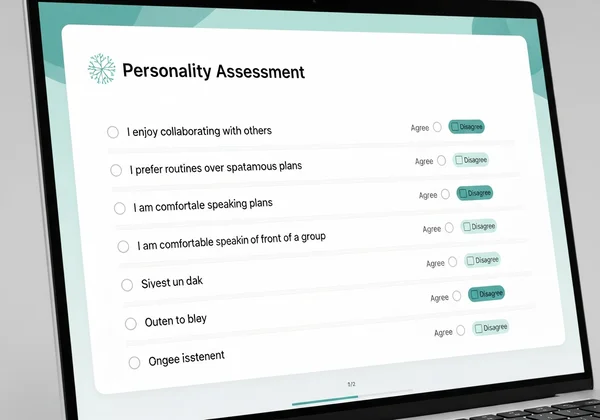
Sometimes, it helps to use an educational tool to inventory these behaviors. While no online quiz can provide a medical diagnosis, assessing the traits you are encountering can be incredibly validating.
If you are struggling to make sense of the conflicting signals, you can check your traits with this narcissistic personality test. It serves as a tool for self-reflection and pattern recognition. Seeing the traits listed out objectively can help you confirm that what you are experiencing is real, not imaginary.
Reclaiming Your Reality
Learning how to deal with a narcissist is ultimately a journey back to yourself. You may not be able to control their outbursts, their silence, or their manipulation, but you have absolute control over your boundaries.
Remember, the most powerful thing you can do is to stop playing their game. Disengage, protect your peace, and seek support from people who can return your empathy. If you need more clarity on the dynamic, try the narcissism test to help organize your thoughts and validate your experience.
Frequently Asked Questions
What drives a narcissist insane?
Indifference. A narcissist craves control and attention (positive or negative). When you become indifferent—showing no anger, no sadness, and no interest—they lose their "supply." Being ignored and irrelevant is their greatest fear.
Is it better to ignore or confront a narcissist?
It is almost always better to ignore or strategically disengage. Confrontation usually backfires because they will deny, deflect, and project blame back onto you (DARVO). Ignoring them via the "Gray Rock" method protects your energy.
How do I know if the narcissist is finished with me?
You will see the "Discard" phase. They may abruptly leave, cut off contact, or treat you with utter coldness as they move on to a new source of supply. However, be wary of "hoovering"—they often return later to see if they can hook you back in.
Am I the narcissist? (The "Gaslighting" Effect)
If you are asking this question and worried about hurting others, it is highly unlikely you have NPD. Narcissists rarely question if they are the problem. This self-doubt is often a symptom of being gaslighted for a long time.